Showing posts with label neurodivergent. Show all posts

Monday, June 15, 2026

Hot Off the Press! New MG from Meg Eden Kuyatt - Perfect Enough


Perfect Enough by Meg Eden Kuyatt

From the publisher, Scholastic, Published June 2, 2026.

The companion novel to the beloved and award-winning Good Different.

Selah is a dragon.

Or at least, she feels like one. And she finally figured out how to spread her wings and soar.

Armed with her sensory tools, her notebooks and poems, and her newfound knowledge about her autism, Selah is heading to writing camp for the summer. She’s excited to work on her writing, perform at the final showcase, and to meet more kids like her.

Things aren't so simple though. As soon as she arrives, she realizes that her bully from home is there too. Ezra is chaotic, attention-seeking, and always teasing her.

Selah is determined not to let him ruin her summer. But soon it turns out that it’s not just Ezra causing problems. . . . As kind and enthusiastic as Selah’s new friends are, they don’t fully understand her autism and how overwhelming this new environment is for her.

Friend drama, classes, overstimulation, and her relationship with Ezra all start to feel like a lot. But surely Selah can make it through just a few weeks without reaching her breaking point again . . . right?


Meg’s books need to get into the hands of all kids and adults. What she writes is relatable and beautiful. She has phrases that elevate and penetrate the soul.

Plus, she opens a window into one girl’s autism while presenting other kinds of neurodiverse kids and adults. Being aware and understanding of what others are dealing with, makes us all better humans. Compassion for others and oneself. Because sometimes what you think is not always the truth of the situation. Friendships can be hard to navigate. 

I’m trying not to give anything away! The reality that some things work out and sometimes they don’t is authentic and it helps to know that it’s okay.

Trying, opening your heart to new things and people, knowing your boundaries and limitations, these are all life lessons and perfectly executed in this story.


#perfectenough

If you haven't read the first book, Good Different, you can read my review here. And then run out and buy both books 😊


Tuesday, May 13, 2025

Neurodivergent MG - The Girl in the Walls by Meg Eden Kuyatt

I am so happy to be on Meg's blog tour with her new book, The Girl in the Walls. There is an interview below that takes us inside her process and new story. And below that are Reading Group questions! Meg's books are needed in this world. You can also check out her first book on my blog, here. 

Her new book in verse is gripping, spooky and mind bending, and about family, secrets, and how we talk to one another. Everyone's feelings are valid and there are so many experiences that go into shaping who we are and who we become. We can also break down the walls that divide us and listen to each other. To find what we have in common. Love each other as we are. And forgive.

The poems are poignant and really connect you with the characters, including the living, breathing house. 


From the publisher: Scholastic Press (May 20, 2025)

There's a ghost in the walls, and V must decide if it is an ally or an enemy. The wrong decision could destroy her and her family.

From Schneider Honor Award winning author Meg Eden Kuyatt comes a chilling and insightful novel-in-verse.

After a hard school year, V has been sent to her Grandma Jojo's house for the summer in order to get away from it all. But unlike neurodivergent, artistic, sock-collecting V, Jojo is uptight, critical, and obsessed with her spotless house. She doesn't get V at all. V is sure she's doomed to have the worst summer ever.

Then V starts hearing noises from inside the walls of the house... Knocks, the sounds of a girl crying, and voices echoing in the night.

When V finds a ghostly girl hiding in the walls, they seem to have an immediate connection. This might be V's chance to get back at her perfect grandmother by messing with her just a little bit.

But the buried secrets go much deeper -- and are much more dangerous -- than V even suspects. And they threaten to swallow her and her family whole if she can't find a way to uncover the truth of the girl before it's too late.

A contemporary novel-in-verse with a ghostly twist by the author of Good Different, this book is about the power -- and danger -- of secrets. The Girl in the Walls will grab you and not let go until the very last page.

INTERVIEW:

We all loved your first book, Good Different, so much! It’s an incredible book with a powerful message. Can you talk about what you wanted to convey with this book, that you might not have with your first MG novel?

I write what I need to learn and work through. My old pastor used to say, “I’m preaching to myself” and I feel the same way about my writing. Like GOOD DIFFERENT, THE GIRL IN THE WALLS is about me processing my feelings. But here, I particularly knew I needed to process pain and grief and reconciliation with loving relationships that can also hurt you. While Selah in GOOD DIFFERENT learns how to be kind to herself, V has to learn to make room for grace for herself as well as others.

In all my books, I really want to show characters as messy, complicated and realistic. That’s a huge focus in this book. We often want to put people into boxes: this person’s great; this person’s horrible. But most people are too messy for a single box. We contain multitudes. I think this is hardest to remember when there’s hurt, but I think this is perhaps when it’s most important to strive to see people’s humanness.

You’ve mentioned that the first bit of inspiration for this book was a photo you found in an antique store, years ago. A sepia photo of a young white girl with the words “Our Broken Doll” written on the bottom. How did that photo lead to this book?

It took a long time! I kept trying to figure out how to write this book, and how to process the feelings that photo evoked for me, particularly as an autistic person.

Being neurodivergent in a neurotypical world can often make you feel like you’re broken or imitating a person. A big part of THE GIRL IN THE WALLS is how we can internalize ableism as a survival mechanism, and how that can bring out our ugliest sides. It can mean we not only think of ourselves as broken, but we think of others as broken too if they don’t follow a certain set of “rules” or expectations. Families can be our biggest advocates but also can hit us where it hurts the most—many well-meaning family members can throw neurodivergent kids under the bus, trying to “toughen” them up for the world, or to teach them to mask, or to get them to act the way they want them to. This is often with the intended goal of helping these kids survive and succeed in this strange world, but it ends up often causing much more harm. As I explored these ideas in my writing, the motif of dolls came up, and I thought back to that photo. I realized the photo could actually be a literal object in the world of the story, and everything came together in a way that made sense and helped me articulate what I had been feeling all along but struggled to find words for.

This book is so much about emotions. About the power of emotions. And about how our feelings and emotions aren’t always a representation of what’s real. Can you talk a bit about the role of emotions in this book?

Emotions are messy, like people. Often, I hear “follow your heart” but I think this is complicated. There is a value to listening to and being aware of our feelings. They can be good warning signs that something is wrong, or that we need to change something in our lives. But if we let feelings be unchecked pilots, I think that’s dangerous. I know my feelings are not reliable narrators, and do not always tell me what’s true. They also change very quickly! I wanted to talk about this messiness for kids, because I think it’s really, really important we have a healthy, balanced view of our feelings. Feelings should be validated but also put into perspective of truth.

The Girl in the Wall is about how everyone has secrets, and hurt, and a story—even if we don’t always like their behavior, it’s worth slowing down to understand those around us. Why do you see that as an important message?

We are in a particularly divisive time. There is so much hate and anger and assumption-making happening, and it’s scary and upsetting. We have so many ways to speak, but so often feel unheard or spoken over. I know I make so many conclusions about people who do things differently than me, and I have to proactively slow down, listen and ask questions. Sometimes I’m really surprised what I hear! I learn, and as a result, I grow. I want to be someone with a spirit of willingness to listen and grow, and I want to model that for the next generation, too.

Finally, the main character, V, always wears fun socks. Are you a fun sock wearer, and if so, what’s your favorite pair?

YES! A few of my favorites are:

Frida Kahlo

 narwhals that say I AM STRANGE AND WONDERFUL

Emperor’s New Groove Kuzko llamas that say NO TOUCHY

We don’t talk about Bruno

Mimikyu Pokemon socks


Reading Group Questions:

1. Did one of the poems in this book in particular stand out to you? Which one and why? 

2. If you had a ghost, what would it look like? What would it feel? What would it say? Write about or draw your ghost. 

3. While V and Jojo have lots of differences, what are some ways that they are similar? 

4. V’s mom says feelings are unreliable narrators. V’s good art teacher says feelings are important warning signs to pay attention to. Do you agree or disagree with each of these statements? Why? 

5. Which character(s) do you relate to most strongly, and why? 

6. Can you think of a time when you felt really, really angry like V and Cat? Try some of these helpful techniques to use and process anger: Journaling, deep breathing, mindfulness techniques, and physical movement that brings joy. Which of these feels most helpful for you?

7. Is there a particular family member who is blamed for the problems in V’s family? What is the impact of blaming one person for a whole family’s problems? What might be a better way for V’s family to address the situation? 

8. How do each of the characters manage their feelings? What do you think about these approaches and their results?

Saturday, April 15, 2023

BLOG TOUR! Good Different by Meg Eden Kuyatt

I am so fortunate to be on this blog tour for an incredible author and book. Not only is there a book blurb, but there’s an author interview AND a giveaway.

This book should be in every classroom. We all need to learn about people different from ourselves: understanding what they go through, why they do what they do and need the things that help them function in the world.

All the way through it, I was in awe of the incredible scenes, language and feelings that struck me. It’s a memorable novel in verse and I love the characters. I know everyone can relate to something in this story. And it’s also helpful to know that what we experience and maybe feel is isolating, is probably more common than we think or know. From excellent teachers to annoying teachers, friends and bullies, family and neighbors, I think there is something that will resonate with everyone in the story. Really, is anyone normal? We’re all individuals and what’s normal to one is not to another.


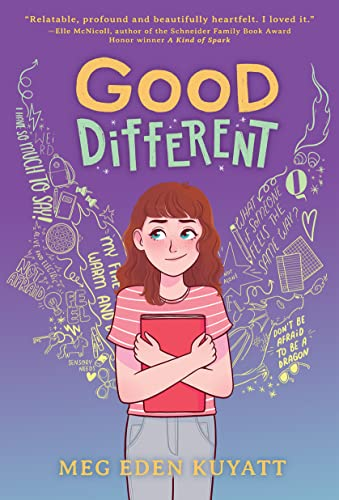
Good Different by Meg Eden Kuyatt

From the publisher: Scholastic Press, April 2023

An extraordinary novel-in-verse about a neurodivergent girl who comes to understand and celebrate her difference.

Selah knows her rules for being normal.

She always, always sticks to them. This means keeping her feelings locked tightly inside, despite the way they build up inside her as each school day goes on, so that she has to run to the bathroom and hide in the stall until she can calm down. So that she has to tear off her normal-person mask the second she gets home from school, and listen to her favorite pop song on repeat, trying to recharge. Selah feels like a dragon stuck in a world of humans, but she knows how to hide it.

Until the day she explodes and hits a fellow student.

Selah's friends pull away from her, her school threatens expulsion, and her comfortable, familiar world starts to crumble.

But as Selah starts to figure out more about who she is, she comes to understand that different doesn’t mean damaged. Can she get her school to understand that, too, before it’s too late?


AUTHOR INTERVIEW: 

Angela Russell: Do you work/teach full time? Do your students inspire you?

Meg Eden Kuyatt: At the moment, I have lots of little jobs—which I think is how I work best. I tend to burn out when I do any one thing too much or for too long, and especially for teaching, I really want to be present for my students and able to give them my best feedback. My students absolutely inspire me! I love how I can teach the same lesson or give the same prompt and they always see new things. I especially love giving prompts like asking them to write what’s inside them, and the things they discover are so incredible. I’m also blown away by my students’ humility and willingness to learn. Especially my students at the community college where I work—they never give any excuses. They have such incredible attitudes and often are juggling so many different things in life that I’m just blown away that they are taking the time to be in my class in the first place. 


AR: What is your writing process and how do you make / find time to write.

MEK: I find that typically I work best every other day, or at least, only making myself write every other day. If I try to force it every day I can stress myself out, and stress is the enemy of creative writing. But really, I’m always playing and thinking. I’m always scribbling down notes and ideas. We make time for the things we love, even if it’s in little bits, and even if there are seasons where we need to refill and step away. I’m learning that I have certain phases with new projects, where I’m so uncertain and asking so many questions, and that scares me, but I’m comforted knowing this will pass and with time, I’ll become more confident!


AR: Do you have any heroes? Yes, though I don’t know where to even start!

MEK: I have lots of heroes but the first that comes to mind is my old pastor, Pastor Ed. Whenever he came up to preach, he made clear that he was actively not there to call out specific people or shame; he was just this guy coming up to tell us what God had been teaching him recently. He was always honest and real about what he was struggling with and learning, so it never felt like this guy talking down to you but with you—and as a kid especially, that was very compelling.


I realize now that as a writer, he has been my biggest influence. When I write stories, I think about his approach to sermons. I ask myself: what am I struggling with right now? What do I need to hear and learn? And that’s the engine for my stories.


I was recently speaking at a conference, and I had this moment where I was absolutely chuffed inside because I heard Pastor Ed’s mannerisms in how I was talking. When he preached, another great thing he did was he had a very clear structure and order. His messages were easy to remember because he organized them in a very logical, practical way. As a speaker, I always really try to emulate this so my audience will remember the points I’m trying to make.


Pastor Ed is a very humble dude, and I think this is part of what makes it easy for me to listen to and respect him (I’m still learning the humility thing). I really love that Pastor Ed always stressed that we should never just take his word for something. We should never believe something’s true because he said it; we should always examine the Bible for what it says is true. This instilled in me a great value for critical, independent thinking (and I want to add here that this included me wanting to decide for myself if the Bible is true and trustworthy), and also makes me as a writer and instructor desire to instill this in my students and readers. I rarely want to be didactic on the page, and I never want to preach to my audience (because unlike Pastor Ed, I am not a preacher!). I want to give my readers questions to think about and wrestle with themselves. I want to give a sense of my stance, where I’m coming from and what I believe, but all I can do is pose an argument. Kids are smart. They are going to decide what they believe for themselves.


AR: There is a definite need in the market for this book and I think it should be in the middle school curriculum.  (not a question – just an opinion ðŸ˜Š)

MEK: Thank you so much! That makes me so happy to hear!


AR: What were your favorite books growing up and do you have any now?

MEK: Anne of Green Gables was a huge one. As I got older, Screwtape Letters was another—I love how it plays with point of view and a story many of us have heard but seeing it from the opposite side. 


I have so many favorite books now, but a few are Elle McNicoll’s A Kind of Spark, anything by Corey Ann Haydu (though my favorite is probably Lawless Spaces or One Jar of Magic) and John Perkin’s Let Justice Roll Down.


AR: Is much of this story based on your experiences? What that where the idea for the book came from?

MEK: Yes and no. Little bits are from my experience and perception, like being at a small private school, or a girl braiding my hair in the recess line and how that came as such a shock to me. Everything I write has some element of my experience—little surface details but even more so, the emotions I’ve felt. This book came from the emotion, from feeling overwhelmed in the middle of COVID and feeling so small and like I had no control. There’s an emotional truth to the story, which is what matters most to me, that even if Selah’s story isn’t literally autobiographical, it captures my feelings of trying to figure out how to navigate living in a neurotypical world. 


AR: Did this come all as one story or did you piece things together?

MEK: This one had a long “incubation period” and many false starts but once I figured out the right starting point and started really drafting, it came together all at once. But really, I’m not sure that’s fair to say. The first draft happened in a very short period of time, but there were years of gathering experiences and ideas that ended up in that final draft. So it’s really both. 


AR: What did you learn/discover while writing it?

MEK: I think the main thing is that I discovered I am actually autistic, and that I have so many ways to fly—that autism has difficulties, but it also has beautiful strengths. I think if it weren’t for this book, I might’ve never sought a formal diagnosis for my autism, so for that I am so incredibly grateful. 


AR: What are you working on next / future projects readers can look forward to? 

MEK: I am in the middle of a few projects. I’m waiting for feedback on a possible middle grade project and am taking a little bit of a breather to play with new ideas until I hear more. I’m also editing a YA manuscript that has taken me at least 20 drafts at this point, but I think (hope) we’re starting to go in the right direction… 


I’m really interested in protagonists with all sorts of different autistic experiences, generational neurodivergence or how people dealt (often maladaptively) with being autistic in previous generations, and I’m really interested in the magic in the everyday. 

Here's a link to all of Meg's book tour events. CLICK HERE  

Here is the rafflecopter link to enter to win an arc of Good Different!

https://www.rafflecopter.com/rafl/display/df05f79b2/.

You can find links to Meg’s books and social media info below:


Twitter: @ConfusedNarwhal

Instagram: @meden_author

Facebook: Meg Eden Writes Poems

Newsletter: http://eepurl.com/buwBXX

www.megedenbooks.com